Showing posts with label 1975. Show all posts

Wednesday, February 11, 2026

«Salò, or the 120 Days of Sodom» (1975)

All's good if it's excessive 

Jeffrey Epstein’s island continues to resurface in world media. People periodically rediscover that certain wealthy and powerful individuals recognize no limits in the pursuit of pleasure. The story is not new; it merely changes its setting. It was written by the Marquis de Sade in the eighteenth century and given cinematic form in the last film of Pier Paolo Pasolini («Salo, or the 120 Days of Sodom»).

Set during the final days of the Republic of Salo, the film portrays the four figures of authority – the Duke, the Bishop, the Magistrate, and the President – who sense that the Republic’s days are ending and they decide to grant themselves the final indulgence. They kidnap nine young men and nine young women and confine them in a secluded villa. There, four old prostitutes tell elaborate stories to stimulate the imagination of the masters. After that, the structured and ritualistic degradation commences.

The totalitarian system completely reorganizes reality and reduces a human being to a mere part in the system. Human beings are stripped of names, identities and even grammatical recognition. They are merely «it» and even God is forbidden. Four impeccably dressed men have pushed Him from His throne.

At certain moments, the humanity can be restored to a certain person. Still, it is granted at the mercy of the Masters and it can be taken back in a second. These rights are not inherent; they are granted at the Masters’ discretion.


Certain resistance exists, but is brief and annihilated without spectacle. Most victims attempt a different concentration camp strategy: survival through betrayal. They denounce each other in order to buy a few more extra hours of life. Totalitarian systems replicate themselves not only through terror but through the offer of minor elevation to a human status, but it means becoming an executioner.

In the final sequence, Pier Paolo Pasolini even dehumanizes the death. Executions occur without speeches or ideological proclamations. Screams are muted and we watch the process through binoculars. Their death looks like the destruction of worn-out furniture.
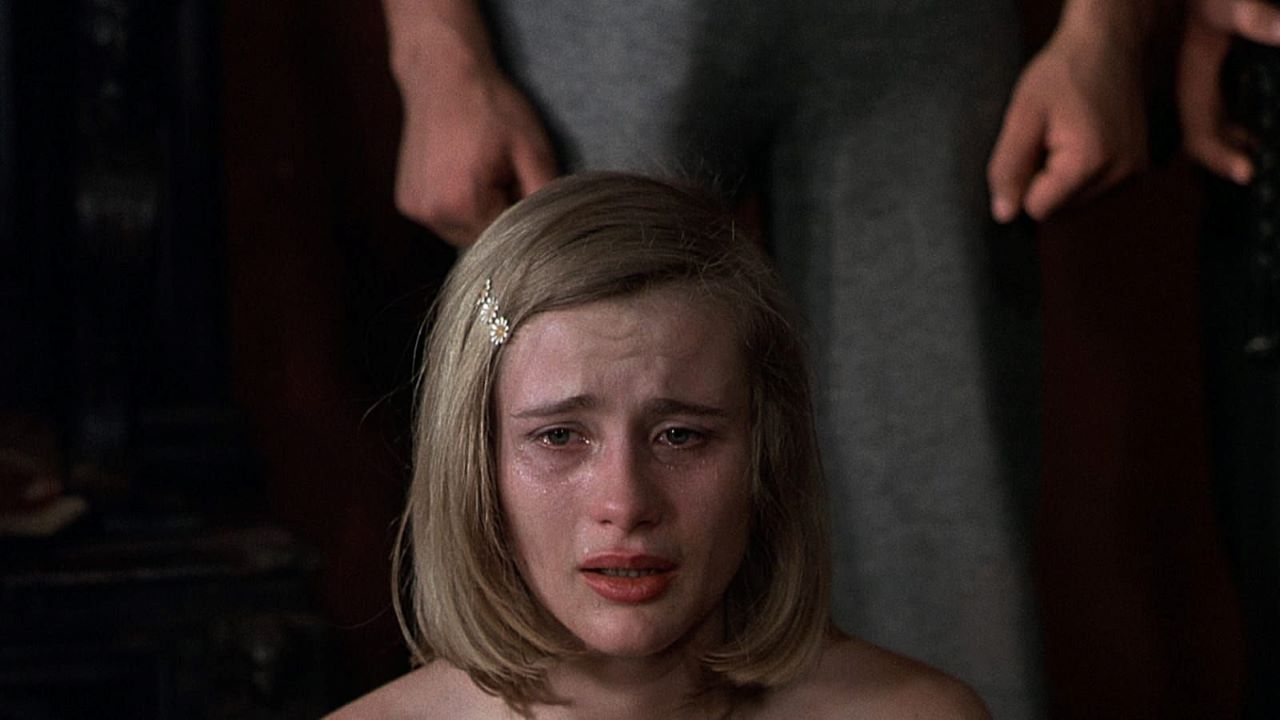
 

There is no place for justice within the world of «Salo». Some perpetrators may face consequences when regimes fall, but most others will quietly dissolve back in the civilian world. Their capacity to objectify and rationalize excess will not disappear after a political change.

Pasolini’s film is not for everyone. It repels and disturbs. Still, it is not about shock content – it is about what happens when power is insulated from consequence, when pleasure is detached from reciprocity, when human beings are treated as disposable components within a closed circuit of privilege.

It is precisely here that the parallel with Epstein becomes disturbing. In order to see this parallel, you need to watch the film and answer this question by yourself.

Tuesday, March 10, 2015

L'important c'est d'aimer

The Love in the Gutter

Andrzej Zulawski has never made the so-called “normal films”. The Director has turned an over-the-top family drama into the mix of horror, parable and philoshopic film essay (Possession); stirred an erotic film with europop soundtrack by a loose adaptation of Possessed, political thriller and drama (La femme publique).

Servais Mont, a photographer, is forced to make pornographic photos in order to pay for his father's debts. One day, he sneaks into the shooting of a third-rate erotic film to make a few photos of a third-rate actress Nadine Chevalier. Servais falls in love with Nadine and he borrows $20,000 from gangsters in order to buy Nadine a part in the avant-garde version of “Richard III”.


First of all, Andrzej Zulawski has made film about love, which is sincere and selfless. The love story begins in a disgusting environment – shooting of a second-rate erotic films, animalistic pornographic copulations, dirty rooms. The Director makes a great use of comparison between real and fake love. Every pornographic photoset is lifeless and doesn't have any beauty. On the other hand, every eye contact between Servais and Nadine is full of despair, suffering and love.

Along with Jules et Jim author, Andrzej Zulawski uses the love triangle scheme. Nadine is married to Jacques – an infantile cinefile, who lost all passion for life and incapable of physical love, but he dragged her out of the misery. The side of the triange is Jacques, who tries to win love of Nadine. Nothing lasts forever and one of the sides has to make a painful choice.


Romy Schneider sleeps, eats and breathes Nadine Chevalier. A woman with a cheap prostitute's make-up, who is forced to play in erotic films. She's torn apart between Servais, for whom she is falling in love, and her husband Jacques, to whom she has moral obligations. Jacques Dutronc as inert Jacques, who perfectly understands his position as a clown and who suffers from incapability to give Nadine love and tenderness, Klaus Kinski in a stunning supporting role as half-mad Karl-Heinz.


L'important c'est d'aimer” is one of the most sincere love stories, The French debut of Andrzej Zulawski doesn't “blow brains out”, as Possession does, but it touches the most hidden parts of your soul.


10/10

Friday, November 28, 2014

L'histoire d'Adèle H.

Those whom the gods wish to destroy they first make mad.

This proverb, wrongly misattributed to Euripides, could easily be attributed to the unrequited love.

Francois Truffaut wanted to film the diaries of Adelie Hugo’s  for seven years. He had constantly changed actresses for the main role, until he saw Isabelle Adjani in «La Gifle». The actress was approved despite the fact that a 19-year old Isabelle Adjani would play a 30-year old woman. 


«The Story of Adelie H.» you could name, in analogy with theatre, a one-person film. Despite the fact that other actors also did a good job, the only actor who draws all attention is Isabelle Adjani.

Isabelle Adjani throws herself completely into Adelie Hugo. She shows every aspect of Adelie’s mental disintegration. The director and cinematographer uses many close-ups in order to show Adjani’s face, her superb facial expression, especially at the final scene in Barbados, when grief-stricken Adelie walks down Barbados with a completely blank face.

Francois Truffaut had chosen the perfect metaphor for progressing insanity of Adelie – nearsightedness. At first, Adelie’s eye vision is correct, but as her possession progresses she see less and less in terms of eyesight and sanity.

Another motive of this film is a contrast. Adelie’s descend into madness is shown by her love interest – Lt Pinson – gambler, lecher and womanizer. Lt’s antipode is the bookseller with certain crush on the main heroine shown as a decent man and who could become her husband. Even casting of Isabelle Adjani is, in some aspects, contrast – such beautiful woman is obsessed with such unworthy man.

«The Story of Adelie H.» has a gloomy atmosphere in a complete contrast with optimism of «Day for Night». The grey town,  the constant sleep drowning of Adelie, the eternal darkness of Halifax, the misery and poverty of Barbados – there is no place for poor Adelie into this cruel and wicked world.


Because of this, you do not feel any falsehood during the watch, compared with many other films. You feel sympathy and compassion towards Adelie and while watching the scene when grief-stricken Adjani cries into the carriage your heart would bleed at least. Every person who loved at least once would find something into this film.

Enclosing, I would like to thank Francois Truffaut for opening Isabelle Adjani’s acting genius to the world audience. I think that after «The Story of Adelie H.», Adjani could have retired from acting because this role has already written her name into the history books. Nevertheless, she had continued her brilliant acting career and has only given joy to her fans all over the world (me included). It is a pity that Isabelle Adjani was passed over for Cesar and Oscar in 1976, but her five Cesars, double prize for the best actress at the Cannes and other innumerable awards are already expecting her.


10/10