Showing posts with label 1989. Show all posts

Sunday, April 7, 2019

"Pet Sematary" (1989)


Sometimes, dead is better

In teenage years, I admired the prose of Stephen King and even now some of his books makes a rather pleasant read. There were many screen adaptations of Stephen King, including too overrated («Shawshank Redemption), great («The Dead Zone»), average («The Tommiknockers») and below the average («The Shining» TV series). After watching an ad for a new screen adaptation of «Pet Sematary», I have decided to revisit the old version, which gave me some creeps after first watching (when I was 10).

The Creed family moves out of Chicago to a small town in Maine, whose main «attraction» is a pet cemetery for animals, who were killed on a nearby highway. Everything goes on as usual, until a favorite cat of Ellie Creed called Church is run over by a truck. Louis Creed is planning to bury the cat, but a neighbor Jud takes him to a Native American part of the cemetery and tells Louis to bury Church there. After some time, cat reanimates and goes back home.


Marcus Aurelius in his «Meditations» agitates us to treat death as a natural thing and not to be afraid of it. It is good and wise words, but most of the people are afraid of death. It is tough to explain to the children, what death really is, and some starts to lie to children that their beloved cat would come back. Also fear of death is carefully exploited by some founders of sects, who are promising eternal life in exchange for blind adherence to their teachings.

And what, if there is a certain supernatural thing, which would bring back our loved ones to life? It could work and reanimate someone, but what would be the price? Any used supernatural power would require more sacrifices and it would wake the hidden fears of humans, so they would sacrifice it the additional material. And the new reanimated creatures would not be sleepy and slow cats.


The good horror films don’t accent on latex monsters; they accent on internal struggle of characters (remember the first «A Nightmare on Elm Street»). Every film character is a separate hero with their internal fears and worries. Racheal Creed is deadly afraid of death; Louis Creed would do anything in order to spare his family from tragedy; Ellie Creed is too little in order to understand death. The supernatural force is starting to exploit those weaknesses.

Mary Lambert is one of those music video directors who has successfully transitioned to a mainstream cinema. She doesn’t use «pianos in the bushes» and flying monsters; she uses simple methods to grow the atmosphere of fear, hopelessness and despair.  Some scene could still cause shivers, and in the end we would encounter some great action scenes. Also the Director shows the illogical nature of a man, who are behaving as junkies, despite the experienced negative effects.


Summarizing all of the above said, I must say, that there is a good adaptation of Stephen King’s novel. «Pet Sematary» is a smart horror film, which keeps the tense from the first to the last second. I don’t even feel the desire to watch the new version. Let’s hope that other Mary Lambert’s films would be as good.

Saturday, March 30, 2019

«Cas sluhu» (1989)


The time for lackeys

On the 8th of April, 1975 Vaclav Havel wrote a letter to the First Secretary of the Communist Party of Czechoslovakia Gustav Husak about a moral, cultural and intellectual crisis of the «normalized» Czechoslovakia. Particularly, the playwright wrote about current political system, which pushes the born lackeys to the top, which are ready for any humiliation and willing at all times to sacrifice their neighbors and their own honor for a chance to ingratiate themselves with those in power.

Vaclav Havel summarized, that such a situation can only lead toward the gradual erosion of all moral standards, the breakdown of all criteria of decency, and the widespread destruction of confidence in the meaning of values such as sincerity and honor. In 14 years after the letter, when CSSR was living its last days, a young debutante Irena Pavlásková shot «Cas sluhu» - a film about Czechoslovakia in words of Vaclav Havel.


In beginning of the 1980s, a young medical student Dana dates a young international relations student Marek, until the day when young Prague inhabitant and a future young diplomat dumps this village girl. Dana gets so devastated and in order to kick Marek, she persuades her girlfriend Lenka to «lend» her boyfriend Milan (a young functionary in the Foreign Ministry) for a one-month marriage.

In 1980, Krzysztof Zanussi showed in «Constance» the closed and unpleasant world of the people, who were able to travel abroad and get foreign currency. Those were the workers, but the «crème» was functionaries in Foreign Ministry and diplomats, which were, rather, specific people. There were big dossiers on every diplomat and functionary and one snitch was a ground for dismissal. That is why their sphere was not characterized by such words, as trust and mutual help.


Any society, which artificially rations some goods (including foreign travel), oppresses freedom ad have a strong repressive apparatus, becomes crueler and nervous. The most enterprising inhabitants of such society are using any methods of advancement and they have real blood on their hands. Later, such people would start a cruel circus of wild capitalism, which was always quite familiar.

In 1980’s Czechoslovakia nobody believes in socialism and in two hours of the film, the only symbol of socialism is a portrait of Brezhnev in some government office. In this Czechoslovakia, everybody is concerned with self-advancement and the success is measured by your level of unscrupulousness.


Dana says that she moved to Prague in order to leave her unscrupulous mother and to earn an honest living as a doctor. Despite that, her subconsciousness remembers only one way of success and she catches the golden train, Dana becomes a cynical and calculating bitch. Even her looks are altered – from a bleak student she transforms into sexy woman, which radiates cruelty, ruthlessness and power.

New Dana promotes only herself and other people for her are merely garbage and instruments, and she doesn’t even bother to hide such attitude. She teaches others how to manipulate, play a double-face and to promote yourself at any price. Dana even helps to further the career of detested husband in order to get a grip on more luxury items. And in the end, a hard currency prostitute would point out Dana as equal, but maybe prostitute’s labor is more «honorable», than Dana’s.


The same letter to Husak, have an interesting passage about societal attitude for the opposing individuals. Vaclav Havel wrote, that those indifferent neighbors may expel opposing person from their midst, for appearance sake while sympathizing with him in secret or in private, hoping to still their conscience by clandestine approval of someone who acts as they themselves should, but cannot.

According to this words, Dana gets «flashes of conscience». She privately praises a colleague of Milan, who is not afraid to speak out, she asks mother to help with employment of Milan’s ex-girlfriend and even speaks out against Milan’s authorities. Furthermore, she takes a pleasant history researcher as a lover and feeds him stories about her upcoming divorce. Does it remind you about a gangster, who sponsors classical music and church renovation?


Despite that, when Dana is faced with true, but materially poor love, she sticks to the unloved husband, because he could provide her with foreign trips and she lost an ability to work and converse with usual people. No, love and truth would never prevail over lies and hatred in her life. And there are tens of thousands of Danas.

Combing the realistic portrait of «normalized» Czechoslovakia, the Director reaches another level with the universal story about internal void, which could happen in any country and under any regime. I agree, that «Cas sluhu» is a film, which parallels such films as «Decalogue» by Krzysztof Kieslowski.


«Cas sluhu» was released on the 1st of November, 1989, and Vaclav Havel was unanimously elected as the President by the Federal Assembly on the 29th of December, 1989. Vaclav Havel tried to heal the sick society, but Danas started to rip off the country. Nevertheless, Vaclav Havel was able to smooth this process, not unlike the other ex-socialistic countries, and not to lose his soul after 14 years of the presidency.

Watch «Cas sluhu», without any politics, maybe it will help you to think.

Sunday, July 31, 2016

In memory of Andrzej Zulawski (Boris Godunov)

Rostropovich said that I have offended the Russians

Isabelle Adjani called the films of Andrzej Zulawski an «emotional pornography». After the release of «The Devil» Zulawski was thrown out of Poland; the shooting of «On the Silver Globe» was stopped and only in 1987 Zulawski got a chance to release his great unfinished masterpiece. Almost every release of Zulawski’s films was surrounded by a negative press and a societal ostracism.

In 1989 Zulawski filmed the opera of Mussorgsky called «Boris Godunov». After watching the final cut, Mstislav Rostropovich tried to sue Zulawski in a French court on the ground that his film offended the Russian soul. Undoubtedly, he lost the suit, but Mstislav Rostropovich insisted that his disapproval would be added in an opening titles of the film.


The Pushkin’s play, which was a basis for the opera, took place during the reign of Boris Godunov and the opening months of the Time of Troubles. Andrzej Zulawski saw in the opera a parallel with the Soviet history and the socialistic countries as a whole: «I desperately wanted to show that Pushkin’s drama, which inspired Mussorgsky, reminds us of the cruelest plays of Shakespeare; it depicts the ideological issues, which concerns us tonight with the most modern passion».

True, the decorations of the XVII century Russia are shown along with Soviet guardian posts. Andrzej Zulawski thinks, that the death of Ivan the Terrible parallel the ending of an authoritarian Soviet regime (the 1940-1950s) and the reign of Boris Godunov depicts the ideological Thaw, which was destroyed be the reactionary forces. Prince Vasili Ivanovich Shuisky depicted as a cunning nobleman, who at first helped to secure the throne to Boris and then called for the foreign intervention and stabbed the Tsar in the back. The same thing happened with some reformists in the Eastern Europe.


As in «The Third Part of the Night» and «Possession», Andrzej Zulawski uses the theme of duality. The part of the Innocent and Grigory Otrepiev was played by the same actor. It is rather symbolical because the Innocent was the first person who publicly accused Boris Godunov of the murder of Prince Dmitry and Grigory Otrepiev claimed that he was Prince Dmitry and became Tsar himself. Also one actor played the part of the murdered Prince Dmitry and Tsar Fedor II Romanov.

Andrzej Zulawski, as in his previous works, took great liberty with the rules and the frames of the genres. In the Zulawski’s opera characters sing as they run, decorations of the XVII century Russian look like avangardist paintings and blood sometimes is pictured in blue. In addition, sometimes opera settings are mixes with filming crew and from time to time characters speak straight to the public.


Compared with many conventional operas, Andrzej Zulawski didn’t shy away from showing blood and violence. It was done in full accordance with his cinematic philosophy in which no attempts to shy away from real history are not tolerated. Truly, why should you try to get away from real history or paint it white. The history of the XVII century Russia was full of blood and we should accept it in this way.


The late Andrzej Zulawski made another controversial picture. It is not a Russophobic vomit of the crazed psychopath, as some critics tried to say, it is his view of the history and literature. For some banal phobias, Andrzej Zulawski was too clever and sophisticated. You too, throw away your stereotypes and try to preserve the legacy of Andrzej Zulawski by watching and discussing his films.


Sunday, March 22, 2015

Polytechnique

If I have a boy, I'll teach him how to love

On the 6th of December, 1989, the life at The Ecole Politechnique was as usual. Nothing predicted a tragedy, until one one young man entered the classroom and shot into the ceiling...


The Ecole Politechnique Massacre was a societal shock. Until this day, there is a raging debate about the modus operandi of Marc Lepine. This film depicts the day of this shocking tragedy.

The director took a formalist approach in depicting the events of The Ecole Politechnique Massacre. Denis Villeneuve doesn't depict any theories or guesses about the modus operandi of the murderer; he merely shows one day in life of students of The Ecole Politechnique. By using this approach, the director follows the cinematography of Michael Haneke, especially his “glaciation trilogy” («The Seventh Continent”, “Benny's Video”, «71 Fragments of a Chronology of Chance”).


The film starts with murder of a female student, who stands near the copy machine. Then, the director gets back to beginning of this day and depicts the day from a different points of view: The Murderer, The Female Student and The Male Student. Politechnique draws a clear parallel with a last film of the “glaciation trilogy” - «71 Fragments of a Chronology of Chance”. Nevertheless, compared with the film of Michael Haneke, all fragments of Politechnique are clearly connected from the beginning.

The director shows an indifference of the society, which led to this terrible tragedy. As everybody knows, you cannot change the history; nevertheless, during the film, there are many moments, when this crime could have been prevented or stopped. Anyway, this terrible crime was committed and, in my opinion, the society takes a larger part of blame for it. It were not the horror films, the violent computer games or some psychological or some other societal theory, it was the society as the whole.


Politechnique is a film which makes you think. This tragedies are happening again and again, but we treat them, mostly indifferent, hoping that it will not touch us.


7/10

Saturday, December 27, 2014

Mes nuits sont plus belles que vos jours

Consider thyself to be dead, and to have completed thy life up to the present time; and live according to nature the remainder which is allowed thee

He – a brilliant computer programmer Lucas – finds out that « No one told you when to run, you missed the starting gun» (quoting the passage from Pink Floyd song called Time). Now, like the main protagonist of Éric-Emmanuel Schmitt’s book «Oscar and the Lady in Pink», every day of his life counts for ten years.


She – a model and telepath Blanche – is the mentally abused girl, who is living in a loveless marriage. Blanche is fed up with her empty life, but she can’t break the circle. Those two opposite men have met in a café; their waltz starts out immediately.


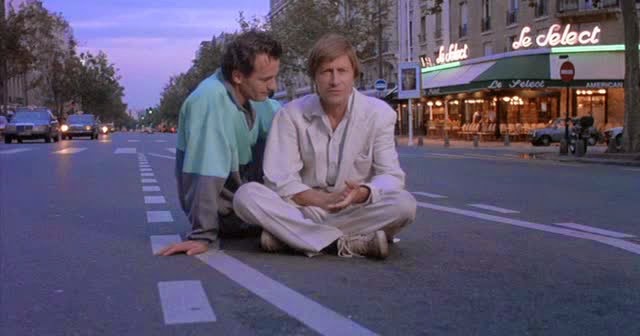
Andrzej Zulawski, after over-the-top «L’amour braque», have made the stunning film. «Mes nuits sont plus belles que vos jours» is a story of love, which is all consuming, mad, doomed and fast.

The film is the most lyric and romantic creation of this director. Nevertheless, in the Universe of Andrzej Zulawski all traditional categories, events and meanings are losing their common meaning, Spectators, who are expecting the traditional love story («love at the first sight-date-romance-…»), would be greatly disappointed.

In the cinematic world of Andrzej Zulawski love is full of pain, suffering and despair. The affair of Blance and Lucas is a mad waltz of two hurt people. They know that they days are limited and desperately trying to squeeze everything out of their love. Their acquaintance starts out with a verbal abuse and violent argument; behind the aggressive façade, you can feel their chemistry.


Jacques Dutronc, besides being a good singer, is a very good actor. He had the experience of working with Andrzej Zulawski in his French debut – «L'important c'est d'aimer». In «Mes nuits sont plus belles que vos jours», The Actor created a convincing portrait of mentally degrading Lucas, who is desperately trying to live fully. Jacques Dutronc portrays the tragedy of a man, whose day of life counts for ten years, by portraying his constant repetition of simple words and phrases, in order not to forget their meaning, self-talking, and examination of his past.

If in «L’amour braque» Sophie Marceau was not very convincing as a modern Nastasia Philippovna because of her acting inexperience and inability to «fly on the most high-octane fuel», which is required for this role (Nevertheless, Sophie Marceau deserves credit for playing Nastasia Philippovna better, than two actresses in the Soviet and Russian conventional adaptations of The Idiot). In this film, she had played, on the edge of her possibilities, the mentally traumatized Blanche. The scenes of her telepathy sessions are full or hatred and real pain; the scenes of her love encounters with Lucas are the cocktail of tenderness and suffering.

«Mes nuits sont plus belles que vos jours» is the stunning story of a doomed and sincere love. After over-the-top «L’amour braque», Andrzej Zulawski found the balance between eroticism, sensibility and his trademark over-emotionality. The film is recommended for the first encounter with Andrzej Zulawski.


8/10