Sunday, March 27, 2016

In memory of Andrzej Zulawski (Trzecia Czesc Nocy)

Oh God, who elevates the most evil ones and puts the whip into their hands

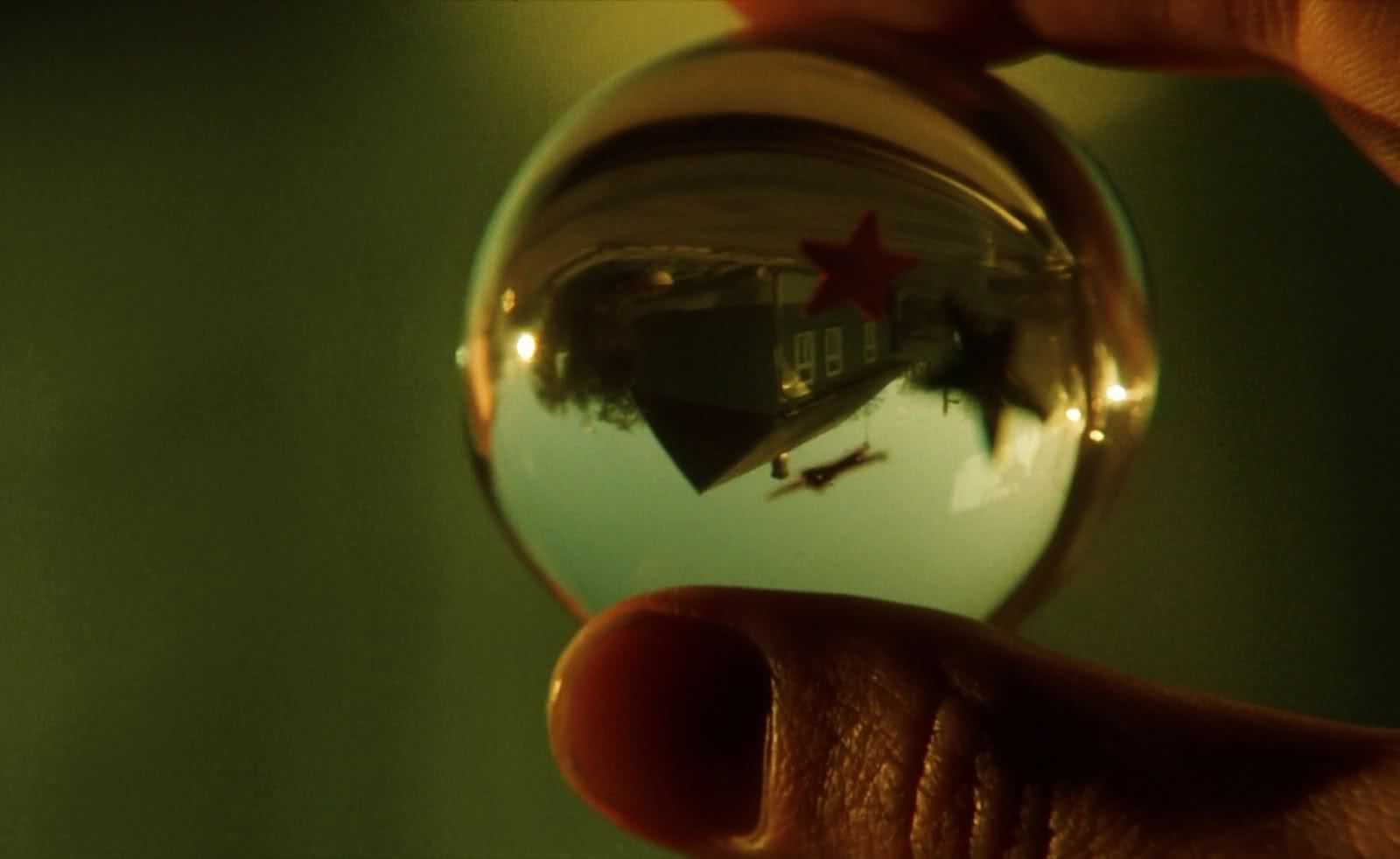
The film starts with a quote from the Book of Revelation: «The first angel sounded, and there followed hail and fire mingled with blood, and they were cast upon the earth: and the third part of trees was burnt up, and all green grass was burnt up» (Revelation 8:7). In the first few minutes of a film, the fourth angel sounded and the Earth turned to the ashes, and there is no sun or moon, but merely the grey sky.


The world is the Anteinferno to which people are taken by trucks. The occupying forces are arriving abruptly in order to bring new souls to Hell or grant the highest mercy – to kill. A young man Michal narrowly escapes the massacre in which his family is annihilated and he tries to become a part of the Resistance. After evading capture, Michal meets a pregnant young woman who closely resembles his dead wife…

As in Possession, Andrzej Zulawski uses the theme of doppelganger. In «The Third Part of the Night» Marta – the doppelganger of a late wife of Michal, - symbolizes one of the people, who has the seal of God. Because of that, Marta is capable of the Miracle of childbirth. After witnessing the Miracle, Michal gets a chance to atone for the past sins. But does it gives him the seal of God?


In an absence of the occupying forces, the lice is destroying soul and bodies of humans. But the lice is the only way to provide for a new family and Michal volunteers to a typhus center as a donor. The lice resembles locusts in Revelation 9:3. The lice doesn’t give a privilege of quick death.


But what is this film about? Is it a parable on Occupation? Is it a hallucination of sick Michal? Andrzej Zulawski doesn’t give the straight answer and invites you to find it by yourself.


Wednesday, March 16, 2016

Happy Birthday, Isabelle Huppert! (Une affaire de femmes)

And pray who are the judges?

Marie Latour, a woman of limited means, raises two children in a ratty flat during World War II in occupied France. In 1941, her husband Paul returns from German captivity, too weak to hold a job. Marie discovers she can make money performing abortions, using a soapy water douche. She buys better food and clothes, looks for a new flat, and, through an acquaintance, who is a prostitute, rents out her bedrooms to hookers during the day.

The film mixes two controversial themes – abortions and Vichy France. Not many directors have made films about one of those topics and even less directors have combined them. Because of that, every such film makes a splash in society and film circles.

The director doesn’t take sides and he is not trying to make a spectator disgusted or compassionate. The title of a film implies neutrality. The film perfectly depicts hypocrisy and double standards of the Vichy France. The society tries to conceal the shame of defeat by returning to so-called traditional values. But the glorious society forgot one of the main Christian values: «Do not judge, and you will not be judged; and do not condemn, and you will not be condemned; pardon, and you will be pardoned».

Marie Latour is not a martyr or an ideal, but her struggle to make end meet is, at least, understandable. She didn’t make anyone to have an abortion; she just wanted to have a better life for herself and her children. In fact, a lot of her clients was not going to become good mothers and sparing the unborn children of hunger and misery is somehow an act of mercy. Much more despicable is Marie’s husband Paul.

Isabelle Huppert depicted Marie Latour as an ordinary woman with whom anyone could easily identify himself. She has a dream to become a singer, to have a better life and other little pleasures as anyone. The Actress has portrayed the variety of persons: the poor mother, the arrogant and successful businesswoman and the broken woman on a verge of death. Undoubtedly, this is one of the best roles of Isabelle Huppert.


I think that for the birthday of favorite actress, one should remind the viewers about one of her best roles. Join me in revisiting this unfairly forgotten film in an illustrious career of a great Isabelle Huppert.


9/10

Sunday, March 6, 2016

In memory of Andrzej Zulawski (Pavoncello)

Are you afraid?

In 1912, Szczebieniew, a rich and ailing old man, comes to Italy with his young wife, Zinaida. One day, in a movie theater Zinaida meets Ernesto Fosca, a young Italian violinist. She invites to the party on a villa and asks him to give her music lessons.

The second feature was also made in black and white. Firstly, almost everyone would be sure that he is watching a conventional love story and Zinaida is ready to run away with Ernesto. Nevertheless, in the XIX century, the noblewoman wouldn’t, with the highest degree of possibility, run away with the common man.


Pavonchello introduces The Idiot, familiar in L’amour braque. In the films of Andrzej Zulawski, The Idiot means a man, who is deeply in love with a fallen woman. As with Dostoevsky, The Zulawski’s Idiot is an innocent man with a pure soul.

In twenty-seven minutes, Andrzej Zulawski has portrayed the story of beginning and crushing of a true love. Let’s not forget this director and let’s keep in memory his art.

In memory of Andrzej Zulawski (Piesn triumfujacej milosci)

This is a song about love

Andrzej Zulawski died two weeks ago and as one my good friend said; that the artists (including directors, actors, painters and artists) should be remembered because of their art, not because of their personalities. Following the words of my friend, I have decided to watch the early works of Andrzej Zulawski.

The first feature of Zulawski is an adaptation of a short story, written by Turgenev. I have a small confession to make; that I haven’t read this story, but, judging by the later films, for Zulawski adaptation is merely a word.


From the first seconds, you could see the technical language of Zulawski: haunting music of Andrzej Korzyński and constantly following camera. The film depicts the story of a doomed love, which would be later present in L’important c’est d’aimer and Mes nuits sont plus belles que vos jours.

Using the minimum of resources and in just twenty-six minutes, Andrzej Zulawski depicts the story of a woman, living in a so-called «normal marriage», which crashes after the first glimpse of a true of love. Beata Tyszkiewicz holds the acting torch, which will be passed to Romy Schneider, Isabelle Adjani and Sophie Marceau.


The first feature of Andrzej Zulawski shows us that the real talent could be a substitute for the lack of technical resources. Some simplicity of this work, compared with later features, is caused only by technical limitations.

Tuesday, February 23, 2016

La double vie de Véronique

Feelings are what link people together, because the word «love» has the same meaning for everybody (Krzysztof Kieślowski)

In 1995, Krzysztof Kieślowski was invited to Oxford University and during the interview he was asked about a role of culture.  Krzysztof Kieślowski said the following: «There are too many things in the world which divide people, such as religion, politics, history, and nationalism. If culture is capable of anything, then it is finding that which unites us all. And there are so many things which unite people. It doesn't matter who you are or who I am, if your tooth aches or mine, it's still the same pain».

Following this pattern, The Director shot in 1991 «The Double Life of Véronique». The main characters are two identical young women called Véronique, albeit one of the is the Polish and other one is the French. After looking at the year of release and remembering about politicized Polish cinema, you would expect a film about Polish renaissance. Nevertheless, the film was not shot for the sake of another political pamphlet.


The film starts with depicting two little girls – Véroniques. For the first 30 minutes, the life of the Polish Veronique is depicted: graduation from a Music College, romance, visiting the aunt in Krakow, good auditioning and offer of a professional choral career. One day, Veronique walks the streets of Krakow and sees in a bus the identical young woman. After the moment, when Véronique had chosen art over love, the film switches to the French Véronique.

«The Double Life of Véronique» deals with the importance of choice in a fast-paced life. In the film the choice is divided between two spheres – art or love? Despite the social and economical differences of characters – Véronique from a rich France and Véronique from a poor Poland; The Director shows that there are many things, outside the spheres of money and politics, which unites the people. Those things cannot be felt or sensed, but anyone can at least understand it by using the «tooth metaphore».


In my opinion, The Director also teases people, who try to make simple things look complicated; who are trying to find the second meaning in everything. The doll theatre scene is illustrating. The children are fascinated, because they can’t understand the forces which move those dolls. At the same time, Véronique is trying to find the Muppet Master and she succeeds; she can’t no more watch this spectacle as a child. The later actions of French Véronique also could verify this opinion, because the only question is «Why are you doing this»?


Watch «The Double Life of Véronique» and, even better, watch it again. Perharps this film will also touch something into you.


Thursday, February 11, 2016

Valentine’s Day Films

The Saint Valentine's Day is not far and I have decided to make a film selection for this very special day!
Film №1. For all those, who believe in love at the first sight!
Damage (1992), directed by Louis Malle.
http://www.imdb.com/title/tt0104237/?ref_=nv_sr_3


Film №2. For those, who don't believe that love lives for three years!
The Night Porter (1974), directed by Liliana Cavani
http://www.imdb.com/title/tt0071910/?ref_=nv_sr_1


Film №3. For those, who don't believe in love triangles!
L'important c'est d'aimer (1974), directed by Andrzej Zulawski.
http://www.imdb.com/title/tt0073155/?ref_=fn_al_tt_1


Film №4. For those, who believe in love triangles or even squares!
Possession (1981), directed by Andrzej Zulawski.
http://www.imdb.com/title/tt0082933/?ref_=nv_sr_3


Film №5. For those, who believe in doing anything for the loved one.
Violette Nozière (1978), directed by Claude Chabrol.
http://www.imdb.com/title/tt0078467/?ref_=fn_al_tt_1


Saturday, January 9, 2016

15 minutes, 17 parties

The Political Constitution of the Republic of Chile legitimized the status of Augusto Pinochet. The President of the Republic was nominated for 8 years and a plebiscite was scheduled in 1988. However, the possibility of plebiscite seemed extremely low. Bowing to the international pressure, Pinochet schedules the plebiscite on 5 of October 1988 with 27 days of campaign. The opposition was given exactly 15 minutes per day on the TV. In normal circumstances, the opposition could lose; in the Pinochet’s Chile the opposing figures could be murdered…


The film starts on the eve of the plebiscite. The majority opinion is that opposition is destined to fail: poorly organized, afraid of the military and, most of all, not believing in a possibility of victory. René Saavedra thinks that the victory is possible. He devises a radical campaign plan by devising Coca-Colesque campaign, targeted on the middle class – Pinochet base, the youth and the potential absentees. René Saavedra wipes out almost all politics from the campaign and brings together the opposition under one rainbow.

Modern sociologists and philosophers have written the innumerable number of pages on the consumer society, especially on willingness to surrender the political rights for the sake of preserving their preferred lifestyle. Symbolically, the first scene depicts showing of an advertisement of a soda called Free. The concept of this ad is that youth fairly satisfied with fictional liberty, music and riot.


A political campaign always aims on the hidden fears. The Pinochet campaign tries to bully voters by claiming that opposition would bring back the socialism and promises the bloodless dictatorship. At the same time, the opposition achieves the impossible – selling to the consumers the ideas of freedom and liberty under a disguise of a Coca-Colesque campaign and mobilize «the great silent majority».

One of the critics said, if one should really celebrate the moment that political activism turned into marketing. I say that, if advertising helped to achieve the great goat, than the film, depicting «The victory of Coca-Cola over dictatorship», deserves a very high mark.


8/10