Showing posts with label 1994. Show all posts

Monday, March 18, 2019

"Trois couleurs : Rouge" (1994)


Fraternite

There are certain encounters (even the short ones) in our life, which catalyzes the most profound changes in our life. 10 years ago I have met a person and we were chatting on different themes and I felt, as if I have known this person for 1000 years. My foolishness was the reason why I lost this person, but I was given a very important last message: «You’re one of those, who consider themselves cynics, but you still didn’t have enough of life. In 10 years you would probably understand me».

I understood those words much earlier, but I have got a chance to say it to this person. That acquaintance lasted for about three weeks, but it was a case for a «full reboot» of my system. I would be glad, if the life of this person would be good, because without this wisdom, I would be still a complete life fool. You would ask me – why am I torturing you with my biography? I am doing this, because even during the first viewing of «Trois couleurs: Rouge» I recalled all acquaintances, which caused the profound effect in my life.


A lot of our life events are dictated by accidents. One negligent word, which causes the mist profound harm to another man; one accidental encounter in unusual place, which causes the most profound changes in our life; acceptance to University, about which you have never dreamed. As everything else, accidents could be positive or negative.

MSU Professor Vladimir Tomsinov always tells the law students the following: «In the law school you are indoctrinated into thinking, that all people are scumbags. You cannot trust anyone. You will be cheated or tried to be cheated by the people, whom you are allowed to do this. What king of lawyer is it, who believes in integrity and honesty of other people?»

Those words could be fully attributed to criminal judges. During their practice they will encounter such things, which would easily destroy any traces of believe in humanity. Also criminal judge, as God, has an absolute power to condemn to prison or death (the latter in some countries). Judge could condemn non-guilty and acquit guilty, but by the time of retirement they reach complete spiritual burnout.


A retired criminal judge Joseph Kern is one of those burned out men, who lost faith in everything. He developed an addiction for human scum and he satisfies it by spying on the neighbor’s telephone calls. Every day brings him closer to complete indifference and loneliness, and even runaway of his dog Rita doesn’t bother the judge too much.

A young student and model Valentine Dussaut is one of the rare type of people, who has «a beautiful soul». One night, she accidentally hits Rita with her car and bring the dog back to the judge. The Judge is not too interested in a dog and he rudely sends away Valentine, but she tells him a few words, which have the most profound effect on the judge’s soul. After some time, the Judge and Student would meet again…

I am not a big fan of poetry, but I remembered one line of «Ulysses» by Lord Tennison: « I am a part of all that I have met ». The main heroes became the «parts of each other» and unleashed the best in them. The Judge no longer feel a need to explore scum, because he regained his faith in humanity; the Students sees a lost man in need of help and not an angry and poisonous old fool. Although they cannot be together because of the huge age difference, their good deeds woulg light their life cycle.


Some critics considered «Trois couleurs» as a manifesto of a New Europe. If they meant a political union, than they were wrong, because it is not a political trilogy, If they meant a possibility for the Polish director to attract French financing in order to make film about common themes of humanity, which would be applauded on the Western film festivals, then they were right.

Krzysztof Kieślowski travelled a long path in his art. If in his first feature film he was a cynic and misanthrope, his last films shows his transformation into the highest form of humanist. The last film enables people to believe, that there are still some kind people left on Earth and their unselfish kindness create an unbreakable bond with other people.

I, as these French girl, who said to the Director about « La Double Vie de Véronique», that this film «made her to believe that soul exists» watched the film beyond the end titles and understood, that something inside of me was better. Thank you, Pan Krzysztof, for giving us the art into the highest meaning of this word. Maybe someone else would also watch the film and feel something good.

Wednesday, March 13, 2019

"Giorgino" (1994)


Je t’aime mélancolie

Milen Farmer rocked the French music world of the 1980s. Music, provocative lyrics and, of course, the first rate music videos, which resembled the actual films. A talented film director and composer Laurent Boutonnat was one of the main architects of Milen Farmer’s success, because he directed those music videos and helped to stage her shows.


Since 1982, Laurent Boutonnat wanted to shoot «Giorgino». In 1992, he finally got the chance and Milen Farmer agreed to act in order to provide some «star power» to the film. The film was released… and became a box office bomb. «Giorgino» grossed about 0,5 million euros against a 12 million euros budget. The critics also destroyed the film, but was it justified?

In October 1918, an army doctor Giorgio Volli got with his regiment under gas attack and became the sole survivor. An attack severely damaged Volli’s lungs and he was medically discharged from active duty. He returns to an orphanage, in which he worked before the war, and finds out that the children were evacuated to another French village. When he makes to the village, he finds out that all children drowned and the villagers suspect, that they were murdered by mysterious Catherine.


The pyrrhic French victory in the First World War did an irreparable damage to the French nation, which became the cause of French defeat in the Second World War. By watching «Giorgino», the spectator would feel the power and verbosity of this national trauma.

A snowy village, surrounded by mountains and deep forests, symbolizes France in 1918. This village is inhabited by women on the edge of madness, who are hoping for return of their husbands/brothers/sons. The wartime cruelty turned children into jackals and one-legged priest symbolizes the phrase of Friedrich Nitzsche «God is dead» (of course in a misquoted context).


Lots of veterans and discharged on medical ground are ending up in a psychiatric asylum, which is merely a chilling alternative to quick combat death. This hell is runned by doctors and nurses, who are also plagued by wartime cruelty, are staging depraved experiments aimed at spiritually killing «rope-marked» patients, instead of healing them.

The disillusioned and bitter French people desire to find a way to channel their anger on someone and they got the motive – death of orphans. Some of the villagers are thinking that the children were killed by wolves, but most of them suspect red-haired Catherine. You should not forget that in the Middle Ages the red-haired girls were considered witches and the war is a fertile ground for the most bizarre beliefs.


On the hand, while watching the misadventures of gassed Giorgio Volli you could draw up a certain parallel with Andrzej Zulawski’s « The Third Part of the Night» and a logical question – if those events are merely the game of sick and dying subconsciousness of Giorgio. You could agree or disagree with me, but first you have to watch the film.

The War will soon end and it will not bring a joy to the nation. On the opposite, the nation would grieve for their fallen ones and experience anger, which could not be satisfied by attacking the state. Every minute of the film multiplies this mood and in the end you would also feel this pain of the French nation in 1918.


The director realized this concept by, among other things, attracting the first class actors, including Louise Fletcher and Joss Ackland. Milen Farmer was also a pleasant surprise. We all know about her great charisma, but she convincingly portrayed a mystique «red-haired witch», which is always a target in war time.

The only weak point of a movie is certain gaps, which slows down the development of tension. I think that in order to train director should have made an «easier» film before « Giorgino», but he preferred that his first film would also be his dream film. Nevertheless, it doesn’t hurt the film.


There are lots of cases, when good films flops at the box office. So, forget about box office and watch the story about real consequences of war. I think that such films are needed, because they illustrate how war is abominable and its consequences. Maybe someone would not talk and joke lightly about the war.

Sunday, January 4, 2015

La Reine Margot

Mes catholiques, mes protestants, réunis tous ensemble dans la Maison de Dieu. C'est un symbole ce mariage, ça va tout arranger!

In my opinion, the book of Alexander Dumas-father «Queen Margot» is not a literary masterpiece. This book is well written, interesting, and enjoyable; nevertheless, it is unrealistic, too romantic and influenced by propaganda against Catherine de Medici. Patrice Chéreau have taken out the best parts of the book, and have created his own vision of the XVI-century France.


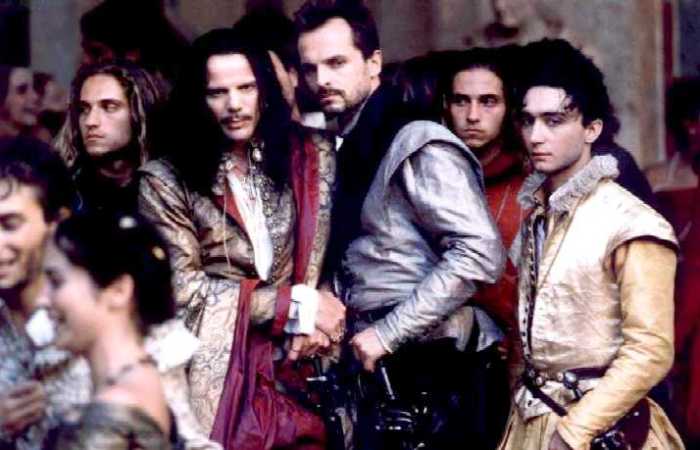
The director drags the spectator into the real Middle Ages – blood, dirt, worthless human life, promiscuity of the French court. Patrice Chéreau portrays France, which is torn by a horrible civil war, when «the brother shall deliver up the brother to death, and the father the child: and the children shall rise up against their parents, and cause them to be put to death».

«La Reine Margot» shows the inner world of a French ruling class with a weak and hypochondriac Charles IX as the nominal ruler. In reality, there is a ruthless political game between Catholics and Huguenots. Neither Admiral Coligny or Duke de Guise are interested in the well-being of France, they only pursue their military and political interests.


The St. Bartholomew's Day massacre depicted as the bloody orgy, which has nothing to do with a religion. In the 10-minute span, the director portrays a graphic portrait of people, who lost all traits of honor and humanity; they are cutting throats of women and children and molest corpses just for fun.

Jean-Hugues Anglade has convincingly portrayed weak and hypochondriac King of France. He clearly understands, that he is merely a toy in the hands of his mother and nobility, but he can’t break the circle. The Actor has brilliantly showed the good side of Charles IX, who is capable of admiring true friendship and abhors violence.

Daniel Auteuil portrayed King of Navarre, and the future King of France Henry IV, who is forced to become a hostage and takes his own «school of unhappiness». King of Navarra is degraded to the spectator of Huguenots genocide, but he is still, compared with Charles IX brothers, capable of a human conduct.


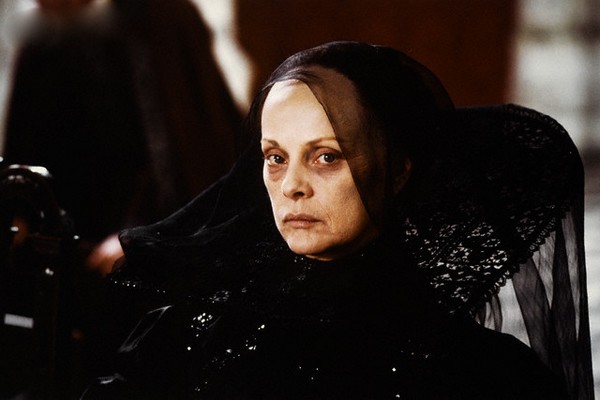
Virna Lisi showed The Princess of Darkness, The Devil in the Flesh, which is morphed in the form of Catherine de Medici. She is the only person, who cares about the future of France. Catherine plays on her own «chess board», but the fate has prepared the different future for her. Despite the blood on her hands, one could feel a certain degree of admiration and compassion towards Catherine, you could even quote Oscar Wilde: «Sin is the only real colour-element left in modern life».


Everyone, who is got used to the «burning» Adelie Hugo, Anna, Camille Claudel and Penelope would be stunned by Isabelle Adjani’s acting. Margaret de Valois is the ultimate Royal consort – cold, arrogant and emotionally distant. The Actress portrayed the tragedy of a woman who was always the other’s people toy; who is stuck in the loveless marriage; whose only form of rebellion is the quick affairs. Nevertheless, Margaret was the only person who found the courage to protect the unloved husband and who become his tutor in the «school of unhappiness».

As Jeanne Moreau in «Les Amants», Isabelle Adjani portrays the transformation of Margaret de Valois by a true love in the form of La Mole. She becomes a woman, who breathes freely and is ready to commit the most selfless acts. Isabelle Adjani’s acting is more restrained, than in her other masterpieces, she relies more on the voice acting, facial expression, eyes. This restrained technique does not make Adjani’s acting weaker, than in her other masterpieces. The last scene of «La reine Margot» could make your heart bleed nothing less than the scenes of «L’Histoire de Adelie H.». After this film, you want to give The Actress a standing ovation. In addition, one would like to thank Mademoiselle Adjani for not wasting her acting genius on the second and third-rate films; she saved herself only for the best.


Others actors were also brilliant. Pascal Greggory as the cunning Duke of Anjou, who is willing to do anything to become a King. Miguel Bosé as the arrogant Duke de Guise. Dominique Blanc as Henriette de Nevers – Margot’s friend and accomplice. Veteran French actor Jean-Claude as Admiral Coligny; the list goes on and on.

«La Reine Margot» is an off-charts brilliant film, which would be interesting to everyone.


10/10